


As a child growing up in Calcutta, I would watch the vernacular film telecast on Doordarshan every Saturday. One film, Biyallish, left a lasting impression. It portrayed Major Trivedi, an Indian officer played by Bikash Ray, serving the British government in Midnapore and responsible for ordering the police to fire on Matangini Hazra during the Quit India Movement of 1942. In the final scene, Trivedi orders the police to fire at a crowd carrying the Indian national flag and marching towards the police station. The native constabulary defies the order, symbolising the weakening of the colonial police machinery as the Second World War raged.
A Colonial Legacy
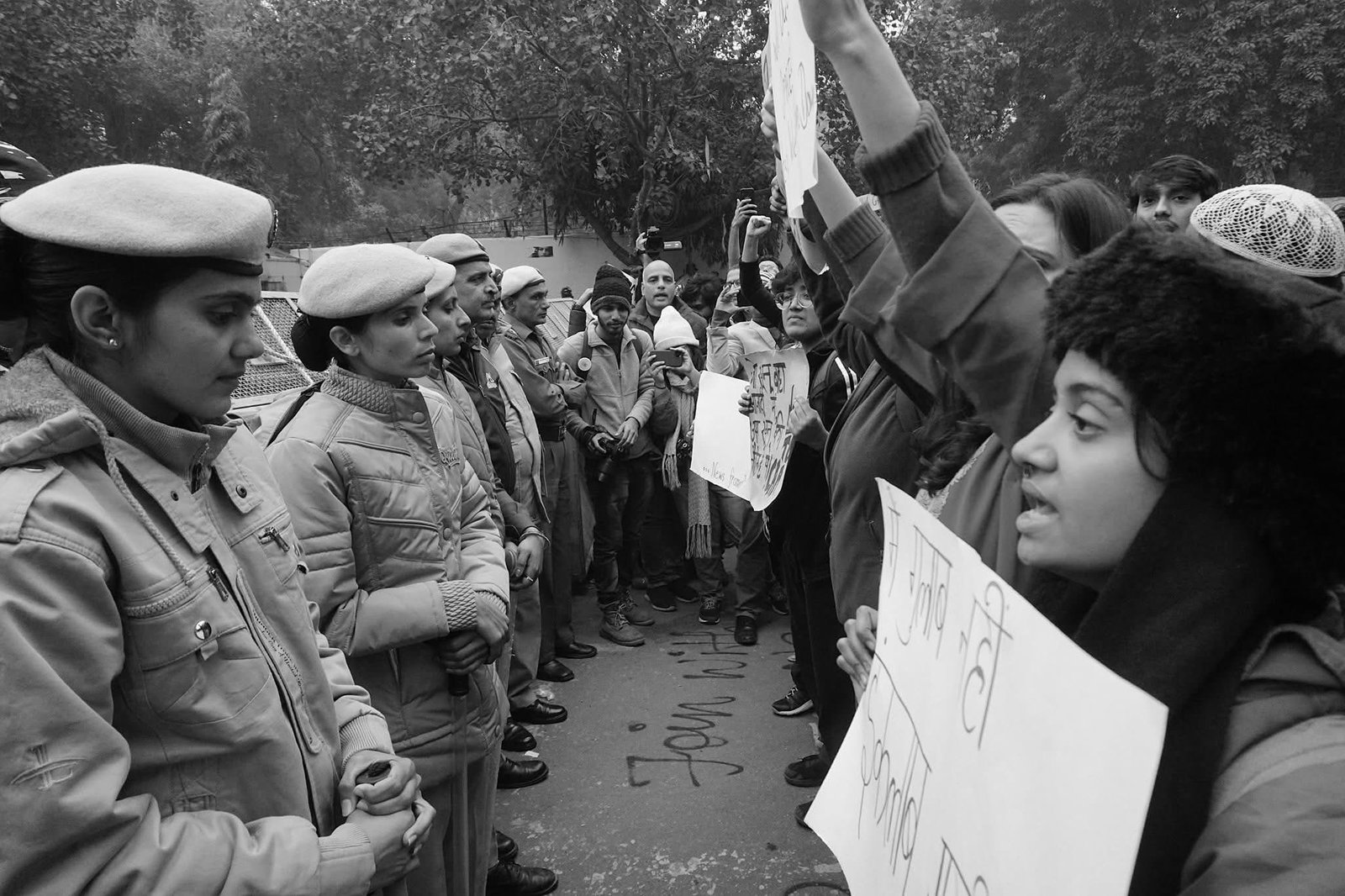
When India became independent in 1947, but what we inherited was largely the colonial bureaucracy and police system. My own encounters with that system began much earlier than my professional life as a journalist. Growing up in the late seventies and eighties, I witnessed the CRPF being called in regularly to disperse protesters. On three occasions, I was caught in the violence, including being beaten with a baton while returning from a salon. The sound of canes striking the ground and the closed shutters of shops remains etched in my memory. Years later, while covering Kashmir, I encountered the same sounds in a professional capacity. I could see how police action, ostensibly intended to restore order, often aggravated the situation.
At its simplest, a protest is an assertion of dissent, while the police are tasked with maintaining law and order. The conflict begins when the state treats the former as a threat to the latter. Article 19 of the Constitution guarantees the freedom of speech and expression and the right to assemble peacefully, subject to reasonable restrictions. Section 144 of the CrPC, now corresponding to Section 163 of the BNSS, has frequently been invoked to restrict assemblies. The Delhi Police Act, 1978, also provides special powers for maintaining public order and state security.
But the existence of these powers does not make every restriction justified, nor does it give the police unlimited authority to suppress dissent.
A Democratic Right
Protest is an essential democratic right, particularly when an elected government is accused of denying people their constitutional entitlements. The recent controversy surrounding the Special Intensive Revision (SIR) of electoral rolls has raised precisely such concerns. According to Election Commission data cited in the controversy, nearly 13.3 crore names had been deleted from electoral rolls across the country, with around 9.5 crore classified under the categories of absent, shifted and other cases. Approximately 2.7 crore deletions were attributed to deaths, while around 1.01 crore involved multiple entries.
India adopted universal adult suffrage from the outset of its democratic journey. Women did not have to wage a prolonged suffrage struggle, as they did in the United States and Britain, to exercise their right to vote in independent India. It is therefore deeply troubling when citizens who have voted in successive elections suddenly find their names missing from electoral rolls.
Electoral rolls must certainly be cleaned up. Deceased voters, duplicate entries, address changes and ineligible registrations require verification. But no citizen should be deprived of the right to vote merely because a Booth Level Officer considers their identity doubtful. Questions surrounding the deletion process, including the changes to Form 6 and the verification requirements imposed on new voters, demand transparent answers. The constitutional guarantees of equality in electoral rolls and universal adult suffrage cannot be treated as administrative inconveniences.
Naturally, people will protest when they believe their voting rights are being compromised. Yet, as demonstrations gathered in New Delhi demanding accountability and the Chief Election Commissioner’s resignation, the Delhi Police responded with restrictions and barricades. Metro entry and exit points being sealed and internet services being disrupted across a four-kilometre radius illustrated how the state’s response could deepen rather than contain public anger.
I witnessed a telling example of the selective application of rules in June, when the Campaign for Judicial Accountability and Reforms (CJAR) was protesting at Jantar Mantar. Although permission was ordinarily required ten days in advance, the organisation received permission on the day itself, June 6.
Excessive Use of Force
I noticed a Rapid Action Force (RAF) constable carrying a pump-action rifle capable of firing pellets. The RAF and other Central Armed Police Forces are trained for crowd-control duties, but the weapons they carry can inflict grave injuries. On July 20, pellet injuries reportedly included a case of blindness.
The police cannot invoke procedural requirements selectively, granting permission on one occasion and citing its absence on another. More importantly, the question remains: how much force is justified against citizens exercising their democratic rights?
In July 2024, the Delhi High Court ordered a CBI investigation into the death of Faizan, a young Muslim man allegedly detained and beaten during the 2020 anti-CAA protests alongside four other youths. His case remains a grim reminder of what can happen when police accountability fails. I also recall December 19, 2012, when outrage over the Nirbhaya gang rape brought people onto Delhi’s streets and towards Raisina Hill. Police tear gas and other measures unsettled a generation of largely apolitical young protesters. I remember offering some of them water and explaining how to cope with the situation.
Kashmir has witnessed far more devastating consequences of unchecked force. Under the cover of AFSPA, security personnel operated for years in an environment where accountability was often elusive. The J&K Police itself does not fall under AFSPA, but the wider security apparatus and the climate of impunity shaped the region’s experience of protest. Deaths and injuries frequently fuelled further demonstrations instead of restoring calm.
One incident from 2008 in downtown Srinagar remains particularly vivid. A large gathering in Nowhatta turned confrontational as stone-pelting began. Police chased protesters through narrow lanes, becoming disoriented and, at times, trapped. Masked protesters continued their attacks before the CAPF arrived and began firing tear gas. Stones kept raining down.
In front of me, a mid-level police officer loaded a magazine of rubber bullets despite his juniors urging him not to fire. He pulled the trigger. The projectile, intended to be less lethal, killed Javed, a young taxi driver who was simply walking home and was not even a protester. What followed was worse: protesters kept hurling stones and the exhausted police personnel struggled to maintain control. Section 144 was imposed, and the day ended in anger and recrimination. In 2011, during another confrontation between police and the public, I was struck on the head by a stone. I accepted it as a professional hazard, but such injuries should never be normalised.
My three decades of reporting have shown me that excessive force rarely resolves the underlying grievance. In Calcutta, outside Writers’ Buildings, where Jyoti Basu governed West Bengal for 23 years, I repeatedly saw police personnel from Lalbazar drag protesters by their hair and beat them. These scenes sometimes appeared on the inside pages of newspapers, but they never stopped people from returning to the streets. At times, CPI(M) cadres, including those associated with the notorious harmad bahini, acted as force multipliers for the police, even when the latter appeared inclined to exercise restraint.
The problem is hardly confined to India. France, too, has witnessed violent confrontations between protesters and riot police. Student demonstrations demanding better teachers and improved school conditions have seen large crowds take to the streets in cities including Lille, Rennes, Nantes, Lyon, Toulon and Marseille. In Paris, thousands gathered at the Place de la Bastille, waving the flag and singing the Marseillaise. As evening fell, riot police used tear gas, crowd-dispersal rounds and baton charges, while some protesters threw bottles and paving stones.
The confrontation echoed the student upheavals of May 1968, when young people challenged conservative university rules and demanded greater personal freedom, including the right of male and female students to visit one another’s residences. The protests shook the political establishment and contributed to President Charles de Gaulle’s eventual departure from office. The lesson is not that every protest must prevail, but that grievances dismissed as insignificant can acquire enormous political force when a government refuses to listen.
Bangladesh offered another example in 2024. Sheikh Hasina’s increasingly hardline response to a youth-led uprising culminated in her ouster and flight to India. Protests can do more than challenge individual policies. When a government repeatedly refuses to acknowledge public anger, they can alter the course of history.
Dismissing Dissent As Treason
India’s own political landscape has changed dramatically since the BJP came to power in 2014 under Narendra Modi. Over the past twelve years, New Delhi has witnessed numerous protests against the policies of the BJP-led government. Yet dissent has increasingly been portrayed as disloyalty, with protesters branded anti-national, liberal thinkers labelled urban Naxals and the so-called Khan Market gang accused of conspiring against the country.
The government’s brazen social-media machinery has promoted its vision of development and Hindutva, while criticism over inflation, fuel prices, unemployment and the erosion of rights has often been dismissed. The complainant is blamed, the questioner vilified, and the protester threatened with prosecution. This is a troubling inversion of democratic accountability.
The confrontation became particularly visible in February 2016, when controversy erupted at Jawaharlal Nehru University over an event marking the anniversary of the execution of Afzal Guru, convicted in the 2001 Parliament attack case. The ABVP and other right-wing groups portrayed the event as anti-national, while student activists were accused of attempting to divide the country. The arrests of student leaders Kanhaiya Kumar, Umar Khalid and Anirban Bhattacharya triggered protests demanding their release.
Kanhaiya Kumar, arrested under the colonial-era sedition provision of Section 124A of the IPC, was assaulted by lawyers at Patiala House Courts while being produced before a magistrate. Some of the same lawyers later marched in protest against JNU students. They burnt an effigy labelled anti-national near India Gate as Delhi Police watched. Traffic was paralysed, but the protesters themselves were not subjected to the same scrutiny. The episode exposed how selectively the language of law and order could be deployed.
The anti-CAA protests that followed in 2019 and 2020 brought these contradictions into sharper focus. The Citizenship Amendment Act, combined with the proposed National Register of Citizens, generated fears that vulnerable citizens, particularly Muslims and the poor, could be subjected to discriminatory scrutiny over their citizenship. The government did little to address those anxieties and instead derided protesters as andolanjeevis (revolutionary creatures), a slur popularised by Modi during the farmers’ agitation.
In Shaheen Bagh, women and other citizens sustained a remarkable sit-in for months. Elsewhere in Delhi, demonstrators poured into the streets, while the RAF deployed tear gas, protective shields and other crowd-control equipment. The government eventually did not implement the proposed nationwide NRC, although the CAA was enacted and subsequently notified. The NRC experience in Assam had already demonstrated the immense human and administrative cost of attempting to establish citizenship through complex documentation requirements.
The Covid-19 pandemic brought the Shaheen Bagh protest to an end as restrictions were imposed. Meanwhile, north-east Delhi was engulfed by communal violence in February 2020, even as Modi hosted US President Donald Trump in Ahmedabad. I remember the smell of smoke, soot and death. It was a sight Delhi had not witnessed on that scale for years.
The pandemic that followed was equally devastating. Crematoriums and burial grounds overflowed, while bodies were transported and disposed of with a grim efficiency that stripped death of its human dignity. Families watched helplessly as their loved ones disappeared behind the barriers of emergency protocols. The official death toll became a subject of intense dispute, with concerns that the actual toll was substantially higher. Yet political campaigning and electoral calculations continued.
The farmers’ agitation presented another major challenge to the government. The three farm laws brought thousands of farmers, particularly from Punjab, Haryana and Uttar Pradesh, to Delhi’s borders, where they faced barricades and restrictions. Farmers from across the country joined them. The government initially dismissed their concerns, but months of sustained protest eventually forced Modi to announce the repeal of the laws in November 2021. It was a significant retreat by a government that had appeared confident that its parliamentary majority would be enough to push through its agenda.
The agitation also demonstrated the limits of the government’s attempts to delegitimise dissent. Modi used the abbreviation FDI to refer to a twisted version, ‘Foreign Destructive Ideology’, while sections of the political establishment alleged foreign sponsorship and Khalistani links. Such accusations did little to resolve the farmers’ concerns. In the end, persistence achieved what denunciation and force could not.
The same pattern of arrogance has repeatedly surfaced in other controversies. From the political fallout of the 2002 Gujarat riots to the more recent anger over the NEET examination paper leak, the ruling establishment has often appeared reluctant to accept moral responsibility. The controversy surrounding the leak, coupled with allegations of irregularities in the examination process and the refusal of Education Minister Dharmendra Pradhan to resign, deepened public disillusionment. The deaths by suicide of NEET aspirants added to the sense of a system failing its young people.
Another episode brought the language of protest into unexpected territory. When the Chief Justice of India used the word cockroach in a reference to young people, it sparked outrage among sections of the youth. An online campaign originating in the United States, associated with Abhijit Dipke, helped popularise the name Cockroach Janata Party as a form of political satire. Whether or not the metaphor was intended as an insult, its reception reflected the growing distance between institutions and a generation struggling with unemployment, examination scandals and diminishing opportunities.
There is also a newer problem confronting protests: the proliferation of social-media content creators who present themselves as journalists. Their intrusive recording and unverified claims can disrupt demonstrations, confuse the public and complicate police operations. Genuine journalists must be able to report freely, but media organisations and professional bodies should also establish clearer means of identifying accredited reporters and distinguishing responsible coverage from deliberate misinformation. Such measures must not become an excuse to restrict independent journalists or citizen reporting.
The larger issue, however, remains the state’s attitude towards dissent. Police forces are not merely instruments for dispersing crowds; they are public institutions entrusted with protecting citizens, including those who criticise the government. Their response can either prevent a confrontation from escalating or turn a manageable protest into a larger crisis. The difference often lies in restraint, accountability and a willingness to listen.
A healthy democracy does not eliminate disagreement. It creates space for it. Governments change, policies fail, and citizens have every right to demand answers. Yet in what is often described as Naya Bharat, dissent is too frequently treated as a crime, and criticism as an attack on the nation itself. Religious polarisation may deliver short-term political gains, but the daily experience of unemployment, inflation and institutional failure can eventually exhaust even a loyal electorate.
We have seen that the 2024 protests in Bangladesh, the repeal of India’s farm laws and the persistence of movements against discrimination all demonstrate that public anger cannot be permanently contained by barricades, batons or labels. A government may delay confronting a grievance, but it cannot assume that the grievance will disappear.
Henry David Thoreau, in his 1849 essay Civil Disobedience, argued that individual conscience must take precedence over unjust laws and that the legitimacy of government depends on its moral relationship with the people. His thinking was rooted in the idea that authority should be limited and that citizens must not surrender their conscience to the state.
Ultimately, democracy is not measured by how efficiently a government silences its critics, but by how confidently it allows them to speak. The police can clear a street, seal a metro station or disperse a crowd. They cannot, through force alone, extinguish the grievance that brought people there.
In a democracy, the people retain the final word. When the time comes to vote, they can decide whether the government has listened to them—or merely tried to silence them.
