






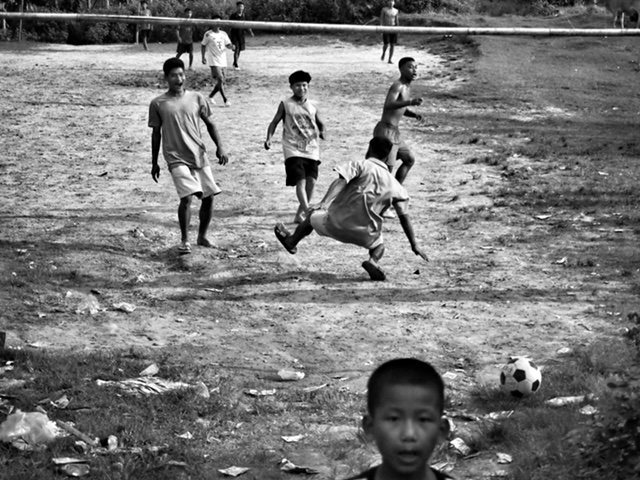
The sport has a billion fans in the country, yet the heartbreak is endless and the system in a perpetual crisis.
Naume Basu
The emotional power of football is what makes this dream so compelling. Watching Lionel Messi’s farewell match for Argentina against Benin, where he scored a goal and provided two assists, reminded me how deeply a legend can connect with his country. Similarly, whenever I play football with friends or economically disadvantaged children, a spectacular goal or knuckleball invariably brings the same name echoing across the field: Cristiano Ronaldo! He is my ultimate idol and theirs, a symbol of how relentless obsession and hard work can take someone from poverty to the pinnacle of world sport. Even at 41, he continues to represent his country with extraordinary commitment.
Ronaldo, Messi and Neymar are household names because children everywhere can watch them play. That makes the plight of Indian football even more painful. Ask an ordinary sports fan to name five current Indian national-team players, and many will struggle. We adore foreign icons while our own players remain virtually invisible in their homeland. Grassroots coverage, media attention and superstar marketing are inadequate. How can children dream of wearing the Blue Tigers jersey when they don’t even know the heroes representing them? We need domestic legends whom children can celebrate in every street and alley.
I remember my father showing me a photograph in his book Shades Of Kashmir. It featured Kashmiri children wearing Messi’s No. 18 jersey, now quite rare to find, while playing cricket. The image was an oxymoron: the GOAT was represented on the field, but the children were playing cricket.
Cricket, in fact, consumes much of India’s sporting oxygen, funding and media attention. Football is steadily growing as the second-most popular sport among urban youth, but cricket is treated as a religion. Children grow up with bats in their hands, round-the-clock television coverage and billion-dollar corporate leagues. When the national cricket team plays, the country comes to a standstill, prime-time headlines take over and sponsors rush to invest. Meanwhile, the national football team fights for scraps. Until football receives even a fraction of cricket’s institutional backing, prime broadcasting slots and cultural attention, our players will struggle to be noticed. I am convinced that more Indians are fond of football than is generally acknowledged.
World Cup Failures
What makes the situation particularly disappointing is that Indian football recently appeared to be turning a corner. In 2023, the Blue Tigers played with courage and belief, enjoyed an impressive unbeaten home run, won the Intercontinental Cup and lifted the SAFF Championship in Bangalore before a packed, roaring stadium. Those victories helped India return to the FIFA top 100, reaching 96th place. Football pages on Instagram and YouTube were full of celebratory edits, and my school friends genuinely believed World Cup qualification was possible.
Then came the collapse. Following crucial qualifying defeats and failure at the Asian Cup, India plunged to 136th in the FIFA rankings. A fall of 40 places in such a short period was a slap in the face for supporters who thought we were finally moving forward.
The gap becomes clearer when we examine performances against stronger opposition. Against Panama, India secured a 1–1 draw, but our players struggled under a high pressure and surrendered possession too easily. Against Brazil, we lost 0–4. India maintained a reasonably organised defensive low block for the first 25 minutes, but once Brazil increased the tempo of their passing, our defenders lost track of runners and appeared exhausted before half-time. The 6–1 defeat against Uruguay was an even harsher reality check. Anirudh Thapa’s equaliser made it 1–1 and briefly sent Indian fans into a frenzy, but the team ran out of energy in the second half. Uruguay’s players sprinted past our defenders, demonstrating that technical ability means little without the stamina to sustain it for 90 minutes.
Is There Any Hope?
The goalkeeping position also needs fresh competition. Gurpreet Singh Sandhu has been a legend, saving India on countless occasions, but concerns about his speed off the line, distribution and handling of high balls make it essential to give younger, quicker goalkeepers opportunities. India needs players capable of reacting faster and building attacks from the back under pressure.
We also desperately need more aggressive, hungry attackers such as Ryan Williams and Edmund Lalrindika. Edmund demonstrated his potential with a remarkable hat-trick in the Durand Cup final, helping his team secure a major victory. Such fearless finishing is precisely what the national team will need as it prepares for a future without Sunil Chhetri, who has long been its dependable source of goals.
Above all, physical endurance must become a priority. European and South American players maintain their intensity for 90 minutes, whereas Indian players often appear exhausted by the 60th minute and begin committing needless fouls. Academies must embrace modern sports science, high-tempo conditioning and tactical education from an early age. Otherwise, India will continue to repeat the same story: enormous potential, but an inability to keep pace with the rest of the world.
There are, however, reasons to remain hopeful. Regional powerhouses and grassroots clubs such as Real Kashmir FC are changing the domestic landscape. Watching a Srinagar club rise through the league divisions and build a passionate following amid freezing snowfall has shown that Indian football is not confined to Kolkata, Kerala or the Northeast.
Kashmiri players are also making their mark. Danish Farooq Bhat, nicknamed the “Kashmiri Ronaldo” by local fans, illustrates the potential of talent from the Valley. With proper scouting and exposure, players from Kashmir can shine at major clubs, including Mohun Bagan SG, East Bengal, Bengaluru FC and Kerala Blasters, and earn national-team caps. Community-driven clubs and youth academies can help bring local talent into the wider footballing mainstream, while Kashmiri players can contribute physical grit and aerial strength to midfield battles.
Ultimately, we must stop looking for talent only in traditional football centres. Kerala, West Bengal, Goa and the Northeast are undoubtedly football-mad regions with outstanding players, but a genuine football powerhouse must draw from the entire country. Punjab, Maharashtra, Karnataka, Tamil Nadu, Jammu and Kashmir, and even small towns in Uttar Pradesh and Bihar could be home to exceptional players who never receive a proper trial or attract a scout’s attention.
At present, an overreliance on established football hubs means thousands of athletic, ambitious youngsters are overlooked simply because of where they were born. Organising grassroots scouting camps from Kashmir to Kanyakumari could dramatically expand India’s talent pool, bringing different playing styles, greater resilience and fresh hunger to the Blue Tigers.
The dream of seeing India at the FIFA World Cup will remain distant unless we turn our passion into a proper system: one that discovers talent nationwide, develops players scientifically, gives domestic football the attention it deserves and builds a team capable of competing for the full 90 minutes.


