

As the Mizo people look toward a modern future, their message to Delhi remains clear: integration cannot merely be military or administrative—it must be rooted in deep, empathetic listening.
Shome Basu
From the window of a propeller aircraft descending through low-hanging clouds into Aizawl, Mizoram presents itself as an endless ocean of mist-shrouded green hills. Yet beneath the serene beauty of India’s eastern frontier lies a complex tapestry of historical trauma, geopolitical fragility, and an unyielding quest for dignity.
For outsiders arriving via the mandatory Inner Line Permit (ILP)—a regulatory safeguard tracing its roots back over a century—the transition into the “Land of the Hill People” feels like stepping into a distinct world. It is a region shaped heavily by isolation; as one local primary school teacher notes, sole airline operations make air connectivity to India’s distant periphery both tenuous and costly.
Sixty years ago, this quiet corner witnessed one of independent India’s most turbulent chapters: an armed rebellion for sovereignty that pitted local Mizo fighters against the full force of the Indian state. Today, as the state navigates a complex political landscape under Chief Minister Lalduhoma, it faces a delicate balancing act between regional autonomy, cross-border smuggling, and an escalating public health emergency.
Famine, Fire, and the 1966 Uprising
To understand modern Mizoram, one must look back at the ecological curse of Mautam. Every fifty years, the mass flowering of bamboo forests triggers an explosion in rodent populations that sweeps through the hills, devouring crops and driving populations to starvation.
In the late 1950s, the phenomenon struck with devastating fury. Elders like Pu Liansiama, who was eight years old during the peak of the crisis, recall when large rats overran homes and fields, leaving nothing behind. “There was famine, and it gave rise to bandits and finally a revolt,” Liansiama recounts softly.
When central food relief failed to reach the isolated Lushai Hills adequately, simmering resentment boiled over. On March 1, 1966, the Mizo National Front (MNF), led by Pu Laldenga, declared independence from India. What followed was an intense sub-conventional war. In a rare and drastic military action on domestic soil, the Indian Air Force bombed pockets of Aizawl and Lunglei, while the military deployed a scorched-earth strategy to quell the insurgency.
Veterans like Pu Zathanvunga—Laldenga’s nephew, who participated in the daring Operation Jerichoambush on the Assam Rifles camp in Lunglei at age eighteen—vividly remember the thunder of fighter jets and months spent hiding in snake-infested jungles on a diet of bamboo shoots. While some rebels sought sanctuary and training across the border in East Pakistan’s Chittagong Hill Tracts (CHT) with external backing, the geopolitical chessboard shifted dramatically after the 1971 Bangladesh Liberation War. Deprived of foreign support, the Mizo leadership pivoted toward a political settlement.
Fragile Peace and constitutional Safeguards
Decades of bloodshed finally concluded with the historic Mizo Peace Accord of 1986, signed under Prime Minister Rajiv Gandhi by Laldenga. The agreement birthed the state of Mizoram and anchored its unique identity in Article 371G of the Indian Constitution, a special provision safeguarding Mizo religious and social practices, customary laws, and land ownership from outside encroachment.
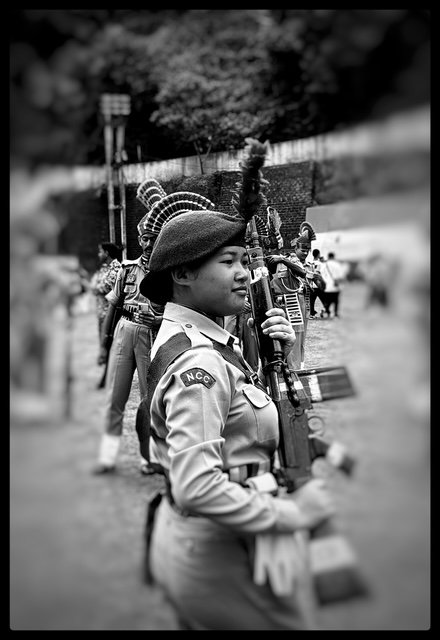
Today, physical scars of war have faded from public view. At Independence Day celebrations in Lunglei, Assam Rifles and BSF contingents march alongside NCC cadets carrying self-loading rifles, cheered on by locals. A profound integration has taken place—built largely on the mutual respect shown by security forces toward local tribal sentiments.
Yet, deep structural challenges remain. Hemmed between Myanmar to its east and Bangladesh to its west, Mizoram’s terrain is both a geographical asset and a security challenge.
Porous Borders and the Golden Triangle Crisis
Geographic isolation continues to hamper the state. While infrastructure projects aim to bridge the gap, treacherous roads, seasonal landslides, and erratic monsoons make travel grueling.
Along the riverine borders—such as the convergence of the Thega and Karnaphuli rivers near Tlabung—the realities of porous frontiers are stark. BSF patrols navigate the “Zero Line” against a backdrop of dense jungles, venomous reptiles, and fluctuating water levels that routinely submerge border fencing. Smuggling networks thrive on these fluid boundaries.
More alarmingly, a devastating public health crisis has taken root. Local voices point to an epidemic of substance abuse, with cheap narcotics funneled across porous borders from Myanmar’s notorious Golden Triangle. Despite Mizoram being a religiously dry state, drug addiction has penetrated nearly every household, stretching state rehabilitation resources thin.
Pluralism, Politics, and a Search for Belonging
Away from geopolitical anxieties, Mizoram’s internal social fabric remains a striking study in contrasts. In towns like Lunglei, churches stand shoulder-to-shoulder with mosques and Hindu temples, reflecting a quiet, functioning secularism where minority communities live free from majoritarian harassment.
Politically, the state continues to chart an independent path. The ruling Zoram People’s Movement (ZPM), led by Chief Minister Lalduhoma, navigates a delicate course alongside regional legacy parties like the MNF and rising national footprints trying to court minority groups such as the Buddhist Chakmas.
Yet, an underlying ache persists among the youth and elders alike. As national integration deepens through education, sports, and civil service, the psychological sting of being misidentified or marginalized as “foreigners” or facing racial slurs in mainland Indian cities leaves a bitter taste.
Sixty years after the smoke cleared from the bamboo hills, Mizoram stands firmly within the Indian Union, guarded by special constitutional compacts and a deep-seated pride. But as the Mizo people look toward a modern future, their message to Delhi remains clear: integration cannot merely be military or administrative—it must be rooted in deep, empathetic listening.
Shome Basu is a New Delhi based journalist and political analyst